Underminers and Deep Green Resistance

Look! Over there on the right. There’s a link to Deep Green Resistance. I only put links to things I think are genuinely useful and important.

Just thought I should get that clear straight away, in case anyone was getting the idea that Underminers was some kind of rival, or alternative to the fomenting DGR movement. It certainly isn’t – they are, while not quite partners, two complementary things that support and reinforce each other in startling ways.

First off, if you don’t already know, Deep Green Resistance is a movement of people, united by the desire to see the end of industrial civilization. In short:

The goal of DGR is to deprive the rich of their ability to steal from the poor and the powerful of their ability to destroy the planet. This will require defending and rebuilding just and sustainable human communities nestled inside repaired and restored landbases. This is a vast undertaking but it needs to be said: it can be done. Industrial civilization can be stopped.

The way DGR aims to work is not easily explained in a paragraph, so I recommend you go here and find out more. Clearly DGR and Underminers (and the burgeoning Underminers Network) has a lot in common, but there are key differences. Underminers is focused on removing the Tools of Disconnection that prevent the vast majority of people from taking back their lives and no longer being part of the industrial machine – I believe that there are currently far too few connected people to make a significant difference.

DGR is about directly attacking the industrial machine, removing its ability to continue destroying the living planet. Like Underminers, it starts from a point where there are already people ready and willing to create change, except that with DGR, that change means actively dismantling the industrial system.

Neither are contradictory. This diagram should help:
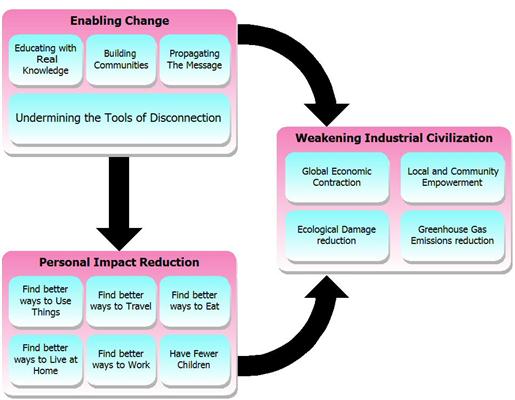
Paths to Change

The Underminers’ world is primarily in the top left box, by which the act of undermining frees up more people to carry out further acts of undermining directly and via a number of side-effects, such as community building. Those people liberated through undermining may not choose to consciously carry out undermining themselves, but through Personal Impact Reduction, they do so anyway, because the effect of this is to weaken the grip of industrial civilization on their daily lives, thus Weakening Industrial Civilization.

The Deep Green Resistance movement comes into its own in that right-hand box, where countless acts are being supported and carried out to directly weaken the industrial machine. I strongly believe that undermining is essential if the DGR movement is to reach its potential. Similarly, DGR is essential in weakening the grip that civilization has over people’s everyday lives – DGR is a both a direct force for change and a form of undermining.

I look forward to this being a truly collaborative effort. We are, after all, in the same boat, and would really like to go in the same direction…at first. What happens after is up to you.


Note: In the light of recent events occurring between the authors of the DGR book, and members of DGR with regards to gender politics, it is worth stating that I wholeheartedly support the fundamental aims of the Deep Green Resistance movement, whilst not necessarily agreeing with the views of all members of the organisation. In any collection of people there will be disagreements – it’s just a shame that a disagreement over something that could have been a long-term goal, has been allowed to manifest itself so virulently.

Americanization, yeah!

Well, it was bound to happen, and so it has. Those who have taken the time to pore over my written output – especially those from the northern part of the continental landmass conventionally called America – are bound to notice that I bring more than a little Britishness to the page. Obviously that’s because of the way I speak, but I have also made a little effort to reach out across the Atlantic and take a sprinkling of Americanisms to the text where it seems appropriate, especially if the subject in question is in that (your?) part of the world.

The online version of Underminers, and the Lulu (soon to be unavailable, get it while you can!) book is written in that British-sort-of-American-with-a-touch-of-Scots way, which is perfectly fine for most purposes and which I have no intention of changing. On the other hand, when a book is about to be pushed out to the North American public (and I mean public rather than the people who would normally seek out my work), then a certain amount of translation is called for. It was explained to me, very understandingly by my publisher, that the convention for books to be sold in the USA is to be written in American English.

Here is where I plead ignorance. Until my gracious and tolerant copy-editor pointed out the multitude of words in the book that were rarely if not ever used in the USA, then I had no idea. The spelling – mainly involving “z”s (pronounced “zee” rather than “zed”) – was perfectly fine; hell! I write “civilization” instead of the British convention “civilisation”, all the time. The words, though, were interesting. Here’s a sample, to give an insight into the process:

Caravan. In Britain, a caravan is a thing that you attach to a car (automobile) and take on holiday (vacation) with you so you have a home-from-home. I had to change it to “motor home”, even though it wasn’t – “travel trailer” is unknown in Europe, so that wouldn’t have worked.

Paracetamol. In Britain, it’s a generic painkiller that acts on the central nervous system. In the USA it’s called acetaminophen and usually Tylenol. I have never taken acetaminophen knowingly, but the converse applies in the USA, so an explanation is now in a footnote.

Football in Glasgow. In Scotland there are (at the moment not, but that’s very complicated) traditionally two big football (soccer – I could have gone native and said fitba’) teams, Celtic and Rangers, or rather Glasgow Celtic and Glasgow Rangers. They are rivals in terms of football, and in terms of different flavours of the same major branch of the same religious belief system – i.e. one is Protestant, one is Catholic. Fights ensue. There is even a new law in place ostensibly to stop fans of one team using religious slurs against the other. This takes time to explain, so I just took the reference out.

Workmate. This is a type of folding workbench produced by the manufacturer Black and Decker that was all the rage in the 1980s in Britain, and which I still have in almost pristine condition from then – they were very well made. I checked, and they are unknown in the USA, so even though I did use a Workmate, to save confusion I took out the whole reference, and just used a saw.

There were lots more, along with all sorts of stylistic changes including a bizarre round-trip. A friend had seen an early extract and pointed out the proliferation of “that” where the word wasn’t really needed in his opinion, such as “the house that Jill built”, which reads more easily as “the house Jill built”. I agreed and spent ages removing every excessive instance. What I didn’t realise is that in the USA, the word “that” is used much more frequently than in Britain, so back a load went! I did re-remove a few, though – you can have too much of anything.

The final edit is complete, and the manuscript is now with the layout people, who will do all sorts of fancy things over the next few weeks. This is the bit where I don’t really get involved much at all – they know how to sell books; I just write the words.